Posts

Showing posts with the label circles

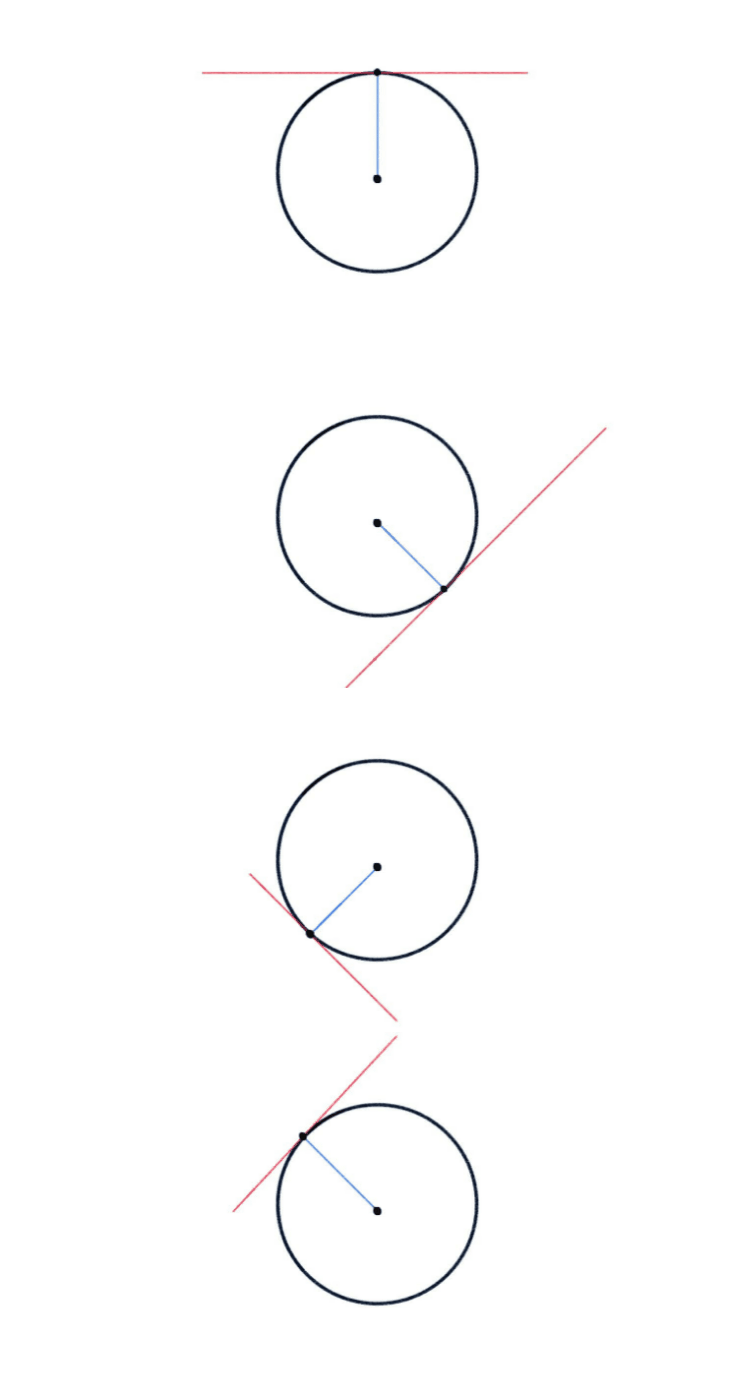
Circle - Tangent at every point is perpendicular to the Radius
Image
Another property we find related to circles is the tangent at any point on a circle is always perpendicular to the radius at that point. Remember that tangent to a circle is a line that intersects the circle at one and only one point.  You can take any point on a circle and draw the tangent at that point, the corresponding radius at that point will always be at right angle with the tangent. ‘Proof by contradiction’ is usually the method used to prove this statement. In this method, we first assume that our statement is not true, i.e, we assume that in a circle the radius is never perpendicular to the tangent.  We then use some mathematical results which will eventually lead us to contradiction. Contradiction means something like “night and day occurring at the same time”, or “x is both bigger and smaller than y(x > y & x < y)”.  Arriving at some sort of contradiction would imply that our initial assumption that radius is not perpendicular to the tangent wa...

Angle Subtended by an arc at the center is twice the angle it subtends on the circumference

Image
I will begin by clarifying the meaning of ‘ angle subtended by an arc at a point ’.  An arc is any portion of the circumference(boundary) of the circle. Connecting the endpoints of an arc with the center of the circle results in the formation of the central angle by the arc . This is what we are referring to as the angle subtended by an arc . Particularly, this is the angle subtended by an arc at the center of the circle, hence the name central angle .  An important theorem on circles states that the central angle of an arc is twice the measure of the angle the arc subtends at any point on the remaining portion of the circumference of the circle. ‘Remaining portion of the circumference’ is just anywhere on the boundary of the circle except the arc in question. In the figure, ABC is an arc, and D is a point on the (rest of the) circumference of the circle. So if x is the angle subtended by arc ABC at (any) point D on the (rest of the) circumference, as per the theor...

Opposite angles of a cyclic quadrilateral are supplementary - Proof

Image
A quadrilateral is said to be “inscribed in a circle” if its four corners(vertices) lie on the circumference of the circle. Any inscribed quadrilateral in a circle is termed as cyclic quadrilateral .  A cyclic quadrilateral has a property that both pairs of its opposite angles are supplementary(their sum is 180 degrees).  In the figure,  ∠ A +  ∠ C = 180°           and      ∠ B +  ∠ D = 180 ° So how do we prove this property?  We just need to prove any one pair of opposite angles to be supplementary. ABCD is a cyclic quadrilateral. But even before that it is a quadrilateral first. Therefore, sum total of all four of its interior angles is 360 degrees.  ∠ A + ∠ B +  ∠ C +  ∠ D = 360 ° If we can prove ∠ B +  ∠ D = 180 ° , it follows from the above equation that the other pair of opposite angles will have to be supplementary too.  ∠ A + ∠ C = 360 ° - (...

Measure of an arc of a Circle

Image
I f the measure of minor arc of a circle is 125 degrees then find the measure of major arc of the circle. An arc of a circle is a portion of the boundary(circumference) of the circle. If the arc is smaller than the rest of the boundary of the circle, then the arc is called Minor arc. And if it is bigger than the rest of the boundary, the arc is called Major arc.  Measure of an arc, or simply arc measure, is the angle subtended by that arc at the center of the circle. In other words, arc measure is the measure of its central angle. The boundary of a semicircle subtends angle 180 degrees at the center. The boundary of an entire circle subtends angle 360 degrees at the center.  In the given example, minor arc of the circle subtends 125 degrees at the center. I will use letters A and P for the end points of this minor arc, and letter O to represent the center of the circle. Connecting the end points of the arc with the center O, the resulting angle ⦣AOP is the angle sub...